Posted by Andraz Radovan
on March 17, 2026

In this article: how different skin problems affect self-esteem, why skin often changes how we behave around others, how we can help ourselves psychologically, and why gentle, compassionate care can be the first step toward a calmer relationship with our own body.
Table of contents
- Skin problems are not just an aesthetic issue
- How skin problems affect self-image
- How we then act in the world
- Why self-image falls so quickly because of skin
- Hedepy perspective, how to build healthier self-esteem
- What we can do to help ourselves
- SkinFairytale perspective, gentle care as a more compassionate relationship with oneself
- What a loving attitude towards skin means in practice
- When it makes sense to seek additional help
- FAQ
- Conclusion
- IMAGE PROMPTS
Quick overview: Key points about skin problems and self-esteem
- Skin problems often affect not only appearance but also how we feel among people.
- Acne, eczema, dermatitis, perioral dermatitis, and other visible conditions can strongly affect confidence.
- Skin can change not only how we see ourselves but also how we present, communicate, and enter relationships.
- With low self-esteem, we often seek more external validation, compare ourselves, and become harsher on ourselves.
- Therapeutic support can help understand these patterns and build a more stable sense of self-worth.
- Gentle skin care is not just a routine, but can also be a more compassionate relationship with the body, especially for sensitive and reactive skin.
Skin doesn’t stay just on the surface
Many people find it hard to admit how deeply their skin actually affects them. It’s easier to say it’s “just a few pimples,” “just a little redness,” or “just sensitive skin.” It’s easier to downplay the problem than to say that a breakout on your face ruins your day. That it puts you in a bad mood. That it makes you feel less relaxed, less attractive, less confident. That because of your skin, you no longer feel completely yourself around others.
That’s exactly why it’s worth talking openly about this topic. Skin problems are not always just something we see in the mirror. They often affect how we enter a room, how we talk to others, how much we dare to be noticed, and how much of our self-worth we start to tie to our appearance.
This doesn’t mean we are superficial. It means we are human. Skin is a visible part of us. When something happens on it, it’s often not a neutral experience. Especially if it’s a recurring condition, hard to hide, or unpredictable when it will flare up again.
That’s why skin holds a special place in our experience. It’s not just an organ. It’s also a place of exposure. A place where body, the gaze of others, and our inner voice often meet.
Skin problems are not just an aesthetic issue
When we talk about skin problems, people often first think about appearance. But those who face these issues know the story is broader. Acne is not just “something on the face.” Eczema is not just “dry skin.” Dermatitis is not just “irritation.” Perioral dermatitis is not just “a rash that will go away.” All these conditions can be physically uncomfortable, emotionally taxing, and very personal.
The skin can itch, burn, tighten, hurt, or react unpredictably. For some, problems appear on the face, for others on the hands, eyelids, neck, torso, or legs. For some, others quickly notice them; for others, the own feeling that their body is no longer calm, beautiful, or “under control” hurts more than the reaction of the environment.
This is important to understand. Many skin conditions are not dangerous to health by themselves, but they can still strongly affect quality of life. Especially when it concerns visible areas, a condition that is hard to hide, or a problem that keeps returning just when you most want peace.
That is why it is unfair to reduce skin problems to a “cosmetic issue.” For many people, they are deeply connected to how they feel in their own skin, literally and symbolically.
Acne
With acne, the impact on self-image is often very direct. Because it often appears on the face, it is hard for a person to overlook. They frequently check, assess, and try to fix it. In worse conditions, the feeling can quickly arise that they are less tidy, less attractive, or less confident, even if they don’t show it outwardly.
Eczema and very dry skin
Eczema and similar conditions often affect not only appearance but also comfort. The skin can be irritated, itchy, burning, and tight. This is not something that “just looks bad.” It is something that follows a person throughout the day and takes away their attention, sleep, patience, and sense of ease.
Dermatitis and reactive skin
Dermatitis and very sensitive, reactive skin often create a special psychological pressure. A person feels they never know exactly what will trigger the next flare-up. This can lead to more control, more fear, and more tension, even when they just want a normal day.
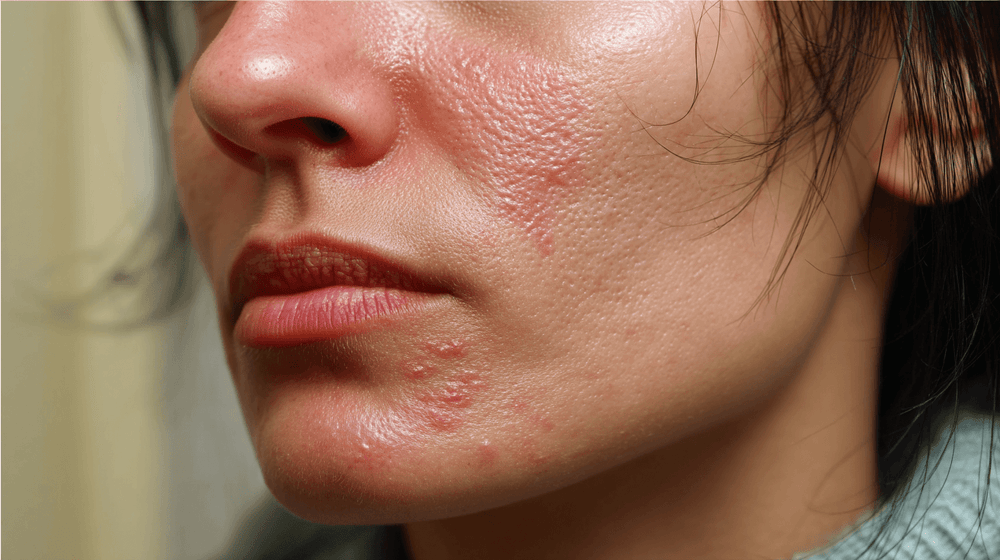
Perioral dermatitis and other visible facial conditions
Especially difficult are conditions that are hard to hide. When there is a change on the face, a person often feels that everyone notices it. In such cases, the problem quickly becomes more than just care. It also becomes a matter of shame, exposure, and inner security.

How skin problems affect self-image
Self-image is not just about whether we think we are beautiful. Self-image is broader. It is a sense of self-worth. It is the way we evaluate ourselves, how much we trust ourselves, how much space we allow ourselves to occupy, and how quickly we condition our value on external reactions.
The skin can strongly interfere with this feeling. Especially if the problem is chronic, visible, or unpredictable. Many people with skin issues develop a quiet but persistent inner dialogue that is much harsher than they would admit. “Why again.” “How can I go out like this.” “Everyone will notice.” “Why can’t my skin be normal.” “There is something wrong with me.”
These thoughts are not trivial. Over time, they begin to shape how a person sees themselves. And if such an inner voice lasts long enough, the skin no longer only affects confidence occasionally, but slowly starts to undermine the fundamental experience of self.
Comparisons, self-criticism, and seeking validation often also appear. A person starts to notice others more. Their skin, their ease, their appearance. And almost always the comparison is unfair. They look at themselves up close, through a magnifying glass, through a bad day, and through their own vulnerability. But they see others from afar, through impression and surface.
That is why skin problems are so challenging for self-image. Because they don’t just hit appearance. They hit the feeling that we are good enough even when we don’t look the way we want.
How we then act in the world
Skin problems often don’t stay just in the mirror. They very quickly start to affect behavior. At first glance almost imperceptibly, but in reality quite deeply.
Someone speaks less at meetings because they don’t feel good about their face. Someone cancels social gatherings. Someone avoids photos. Someone feels they have to be otherwise perfect if their skin isn’t. Someone is less relaxed in relationships. Someone finds it harder to flirt. Someone starts speaking more quietly, laughing less, making less eye contact, taking fewer risks.
This is an important point. Skin often changes not only how we see ourselves but also how we present ourselves in the world. We expose ourselves less. We withdraw faster. We seek external approval more. We put more energy into making sure others don’t “see us too much.”
For some, a subtle form of adjustment also appears. They don’t directly say that their skin limits them. But in reality, they do fewer and fewer things where they would be noticed, close to others, or spontaneous. This is not laziness, superficiality, or exaggeration. It is a very human consequence of inner insecurity that skin problems can amplify.
When we understand this, it becomes clear that the problem is not only on the skin. The problem is also in how much it starts to define our place in the world.
Why self-image falls so quickly because of skin
One reason is very simple. Skin is visible. It is not something we can always hide or put aside. Especially on the face, we feel exposed all the time. And if a problem appears there, we often experience it as a direct blow to our social security.
The second reason is unpredictability. Many skin conditions are not stable. One week is better, the next worse. One product works, then suddenly it doesn’t. Sometimes the problem worsens without an obvious reason. This unpredictability quickly creates a feeling of loss of control in a person, which is especially stressful for self-image.
The third reason is that skin quickly connects with identity. Especially if the problem lasts for a long time. A person no longer says “I have a skin problem,” but starts to feel “I am problematic,” “I am not beautiful enough,” “there is something wrong with me.” This is a very painful shift. And this is exactly where it is important to notice it.
Skin is part of our experience, but it is not our entire worth. This is easy to write, much harder to live by. And that is exactly why this topic deserves more seriousness than it usually gets.
Visible aspect: how to build a healthier self-image
When skin problems start affecting how we see ourselves, it’s important to know that the solution isn’t always just to “become more confident.” Such advice is too general and often unhelpful. Self-image doesn’t change just because we say so. It changes when we begin to understand our inner patterns, our relationship with ourselves, and how strongly we tie our worth to external reactions.
This is exactly where the therapeutic perspective has great value. For the first time, a person can truly see how often they judge themselves, how much power they give to others’ views, how quickly they compare themselves, and how much their sense of self-worth depends on whether they “feel good enough” on a given day.
This is important also because low self-esteem is not always obvious. Some people hide it very well outwardly. They act loud, neat, competent, and confident. Inside, however, they are extremely hard on themselves. Hedepy highlights this well in its content, showing that many people struggle with doubts about their own worth, even if you would never guess it from the outside.
A therapist’s comment here might sound like this: healthy self-image doesn’t mean feeling perfect every day. It means not falling apart every time we aren’t the way we want to be. It means being able to endure a bad day, worse skin condition, or a look in the mirror without a complete internal attack on ourselves.
Therapy can be very valuable because it helps separate appearance from worth. It helps recognize perfectionism, people-pleasing, excessive self-criticism, and dependence on others’ approval. It also helps a person develop a more realistic, less punitive relationship with themselves. Not so they stop caring about how they look, but so that appearance no longer defines their entire sense of self-worth.
Pri vsem tem pa je ključno, da pot do podpore ne postane še en dodaten vir stresa. Psihoterapevtska platforma Hedepy omogoča, da se o teh globljih plateh samopodobe pogovorite s strokovnjakom na način, ki vam v tistem trenutku najbolj ustreza – bodisi preko video klica v zavetju lastnega doma, bodisi v živo v terapevtovi pisarni. Pravega strokovnjaka pa lahko najdete prav preko testa ujemanja, ki vam najde najbolj ustreznega terapevta za vas. Strokovna podpora pri vprašanjih samopodobe ne pomaga le pri 'boljšem počutju', ampak nudi konkretna orodja, kako ločiti svojo vrednost od odseva v ogledalu. Ker je za uspeh terapije najbolj pomembno prav zaupanje, platforma omogoča, da terapevta brez slabega občutka zamenjate, če začutite, da niste na isti valovni dolžini. Že to, da nekomu na glas zaupate, kako močno vas te težave v resnici obremenjujejo, prinese izjemno notranjo razbremenitev. To je pogosto tisti prvi, morda najpomembnejši korak, ko svoji samopodobi nehate postavljati pogoje in se začnete zares poslušati."
Za ta prvi korak vam Hedepy ponuja 15 EUR popusta na prvo srečanje, s kodo:
STRES15
How to help your self-image when your skin burdens you deeply
1. Notice how you talk to yourself.
If you become immediately hurtful, harsh, or panicked with every skin flare-up, the problem isn’t only on the skin. It’s important to notice the inner voice because it often hurts more than the condition itself.
2. Separate a bad skin day from your worth.
Worse skin condition is not proof that you are less attractive, less worthy, or less desirable. It’s a condition. Not an identity.
3. Reduce comparison.
Especially on social media. Most people don’t show their skin at its worst, but you compare yours exactly when you feel the worst.
4. Don’t wait to live until you have “perfect skin.”
This is one of the hardest but most important points. If you keep telling yourself that you will truly live only when your skin is better, you give it too much power over your life.
5. Accept that help is legitimate.
If skin problems burden you psychologically, it’s not an exaggeration. It’s a real experience. And real experiences deserve support.

What we can do for ourselves when our skin starts to define us
Sometimes we can’t immediately solve the cause. But we can start treating ourselves differently. This is not a small thing. It is the foundation.
First, it helps to notice how often you check your skin. Some people look in the mirror ten, fifteen, twenty times a day. Not because it helps them, but because they seek a sense of control. In reality, such checking usually only makes them more anxious. So you can help yourself by observing your skin more consciously, less compulsively.
It also helps to ask yourself how much you have been adjusting your decisions to your skin lately. Have you given up any plans? Have you withdrawn? Have you exposed yourself less? Have you been harder on yourself? These questions aren’t to judge yourself. They are to understand how much space the problem has already taken up in your life.
The next step is to consciously build a different response. This can mean spending less time on profiles that make you compare yourself. It can mean more kindness when looking in the mirror. It can mean going out among people even when you don’t feel perfect. It can mean stopping acting as if you are only worthy on good days.
Self-image doesn’t change in one big moment. It often starts changing in small, repeated decisions where you stop treating yourself as a problem over and over again.
SkinFairytale perspective: gentle care as a more compassionate relationship with yourself
When our skin causes us distress, we often react very sharply. We want to “fix it.” We want to “repair it.” We want to calm it, dry it, smooth it, hide it, or eliminate it as quickly as possible. This reaction is understandable. But with sensitive, dry, reactive, or problematic skin, it often leads to even more tension, more product switching, and a greater feeling that we are at war with our own body.
This is exactly where the SkinFairytale approach is very important. It doesn’t build on aggressively punishing the skin, but on support. On the logic that sensitive skin needs thoughtfulness, not panic. That reactive skin needs fewer irritants, not more chaos. That the skin barrier is not something secondary, but the foundation from which the feeling of comfort can even arise.
Skin that is sensitive, tight, red, itchy, or easily irritated often doesn’t need a routine that constantly tests it. It needs care that allows it more peace. This means fewer unnecessary irritants, more emphasis on protection, more consistent barrier support, and more respect for the skin’s limits.
This is a very important shift. Care is not necessarily just something you do to look better. It can also be a way to show your body that you won’t constantly fix it with anger. That you will try to understand it. That you will offer it more comfort, less aggression, and a more stable framework.
What a loving attitude towards skin means in practice
This phrase can quickly sound too soft or useless. That’s why it makes sense to translate it into actions.
A loving attitude towards your skin does not mean you don’t care how it looks. It doesn’t mean you ignore the problem. It doesn’t mean you pretend nothing bothers you. It means something much more concrete. It means you don’t respond to your skin with additional violence.
In practice, this means:
- not to rub your skin because you are angry at it,
- not to change products every other day out of desperation,
- not to overdo active steps just because you are scared,
- to allow yourself a routine that is simple, stable, and soothing,
- to observe your skin with interest, not just disappointment.
This is especially important for sensitive skin. Skin that is already easily overwhelmed rarely responds well to pressure. But it often responds well to consistency, gentleness, protection, and the feeling that someone finally stops pushing it beyond its limits.
This not only changes the appearance of the routine. It also changes the attitude. And sometimes that is exactly what is most missing. Not another “strong” product, but the feeling that care is no longer a form of dissatisfaction with yourself, but a form of support.

When it makes sense to seek additional help
You don’t have to wait until everything becomes unbearable. This applies both to the skin and to self-esteem.
It makes sense to consider additional professional help for the skin when:
- the condition often recurs or worsens,
- the skin burns, itches, or hurts a lot,
- you are not sure what you are dealing with,
- home care does not bring enough relief.
It makes sense to consider therapeutic support when:
- your skin severely limits you in relationships or daily life,
- you notice a lot of shame, self-criticism, or comparison,
- you withdraw from the world because of your skin's appearance,
- you feel that you can no longer separate your values from the condition of your skin.
You don't have to choose between one or the other. Sometimes the most sensible approach is a combination. We help the skin from the outside, and ourselves from the inside. This is not an exaggeration. It is a mature attitude towards a problem that touches multiple levels of our lives.
FAQ
Can skin problems really affect self-esteem?
Yes. Especially when it involves visible, recurring, or unpleasant conditions like acne, eczema, dermatitis, or perioral dermatitis, skin can strongly impact self-confidence and self-worth.
Why does my skin affect me so deeply even though I know it’s not everything?
Because skin is not just a surface. It is a visible part of us connected to feelings of exposure, safety, attractiveness, and social contact. That’s why its condition often also affects us psychologically.
Does therapy help if my skin’s appearance burdens me greatly?
Yes, it can. Therapy can help understand internal patterns of self-criticism, comparison, and linking self-worth to appearance, and help build a more stable relationship with yourself.
What kind of skin care is appropriate when my skin also emotionally burdens me?
For sensitive, dry, or reactive skin, a gentle, stable routine that supports the skin barrier, reduces irritation, and does not treat the skin as an enemy is often the most sensible approach.
How can I help myself if my skin defines me more than I would like?
It helps to observe your inner dialogue, reduce comparisons, reduce compulsive skin checking, have a more realistic attitude toward progress, and, if needed, talk to a therapist.
Expert perspective
"Skin problems can quickly affect how we see ourselves and how we feel among others. Often, we unintentionally start to link our worth to our appearance.
From a logotherapeutic perspective, our value does not come from how we look, but from who we are as a person. Therapy can help us develop a gentler and more compassionate relationship with ourselves, where skin is no longer a measure of our worth but just one part of our story."
Ula Sok, logotherapy psychotherapy specialist
Conclusion
Skin problems do not define your worth. But it is completely legitimate for them to hurt you. It is completely legitimate for a bad skin day to shake your confidence. To tire you. To sometimes make you less relaxed, less brave, less open. This is not a sign of weakness. It is a sign that you are human and that your outward appearance sometimes intertwines with your inner sense of security.
What’s important is that you don’t face this alone against yourself. That your solutions aren’t just more self-criticism, more fixing, and more pressure. Sometimes the biggest change comes from being gentler with yourself. From starting to care for your skin as something that needs support. And allowing yourself psychological help when you notice the problem defines you more than you would like.
The goal is not perfect skin. The goal is that your skin no longer defines your entire worth. And that even on a bad day, you don’t lose touch with yourself.

Important: This article is for informational purposes only. It does not constitute a diagnosis or medical advice. For pronounced, painful, persistent, or rapidly worsening skin problems, consulting a healthcare professional is advisable. Therapeutic support can be an important part of boosting self-esteem and coping with stress, but it does not replace medical treatment when needed.