Posted by Andraz Radovan
on March 17, 2026

In this article: why stress often shows on the skin, why acne, eczema, and dermatitis worsen more often during stressful periods, how therapeutic support can help, and how to adjust skin care during such times to soothe and support the skin’s barrier.
Table of contents
- How stress affects the skin
- Why acne, eczema, and dermatitis worsen with stress
- Skin and psyche, a vicious circle that many people underestimate
- What a therapist says and how to help yourself with stress
- How to adjust skin care during stressful periods
- Which ingredients make the most sense during this period
- A practical mini reset for skin and the nervous system
- When it’s time for additional professional help
- FAQ
- Conclusion
- Image prompts
Quick overview: Key points about the connection between stress and skin
- The skin often shows very quickly that the body is under prolonged pressure.
- During stressful times, acne, eczema, dermatitis, itching, and tightness of the skin can worsen more frequently.
- Skin problems are not “just an aesthetic issue” because they often affect confidence, well-being, and relationships.
- In chronic stress, talking to a therapist can also be very helpful, not just changing your routine or getting more rest.
- During high-stress periods, the skin often needs gentler, more consistent, and more barrier-focused care.
- Instead of overloading with new products, it’s often wiser to simplify your routine and choose soothing, protective ingredients.
Skin as a mirror of your inner state
Almost everyone who has dealt with sensitive, reactive, or problematic skin knows this feeling. For a while, the condition is calm. Then comes a tough week. Less sleep, more obligations, more internal pressure, less time for yourself. And that’s exactly when the skin reacts. More pimples appear. Redness is more pronounced. Itching is stronger. Areas that were almost calm flare up again.
Many people then look for the cause in a single product, one type of food, or one mistake in their routine. In reality, the picture is often broader. The skin is not a separate world. It’s a living organ that responds to what’s happening inside the body and to our internal state. That’s why it’s not unusual for the skin to behave differently than usual during times of stress, overload, or emotional exhaustion.
This doesn’t mean the problem is “just in your head.” Quite the opposite. It means the body and skin work more closely together than many realize. When we feel threatened, tense, or chronically overwhelmed, the body no longer operates from the same sense of safety. This can affect skin sensitivity, its ability to retain moisture, regeneration speed, and how strongly it reacts to external irritants.
The skin is often the first reminder that the pace we live at is no longer neutral. What has been happening “inside” for a long time begins to show on the outside.
Why acne, eczema, and dermatitis often worsen with stress
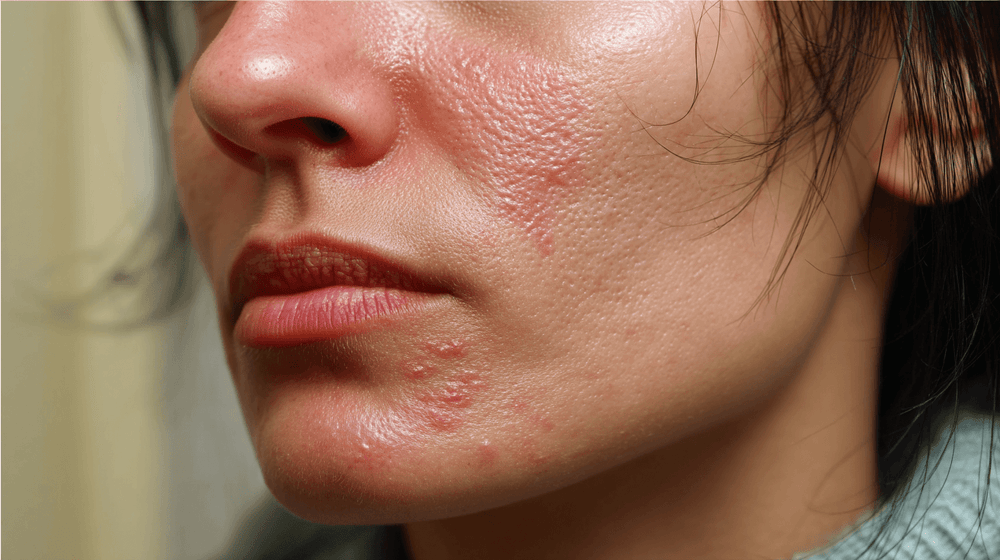
Stress doesn’t affect everyone’s skin the same way. For some, more pronounced acne appears; for others, itchy and dry patches; for others, a burning sensation, peeling, or increased sensitivity to products they previously tolerated well. What they all have in common is that the skin often becomes harder to calm during stressful periods.
When acne worsens due to stress
Acne is often linked to hormonal fluctuations, oilier skin, inflammation, and lifestyle. Under stress, this is often accompanied by poorer sleep, increased tension, less patience, and impulsive decisions in care. People tend to squeeze their skin more, reach for more aggressive products faster, and overdo cleansing more often. The result is not necessarily cleaner skin but often even more irritated and unbalanced skin.
When a person is under pressure, they want a quick solution. But during such times, the skin often doesn’t need a stronger attack but more stability, more consistency, and fewer impulsive changes.
When eczema becomes louder
In skin prone to eczema, stress often shows as more intense itching, dryness, burning sensation, tightness, and faster worsening after irritants that the skin can tolerate better in calmer periods. Someone feels that the skin “just can’t handle it,” that everything bothers it, and that more is happening on the surface than they can manage.
Eczema is not only physically uncomfortable. It is also psychologically exhausting. Itching can disrupt sleep, and poor sleep further reduces resistance to stress. This quickly closes the circle.
Dermatitis and a compromised barrier
In dermatitis, sensitive, and reactive skin, one of the key issues is the skin barrier. When it is weakened, the skin loses moisture faster, retains balance less effectively, and reacts more strongly to external factors. During stressful periods, this can be even more pronounced. The skin becomes drier, more unpredictable, and more sensitive to everything from weather to care, friction, and its own touching.
That is why, in such periods, it doesn’t make sense to think only in terms of “what else to add,” but also in terms of “what can I simplify to help the skin calm down more easily.”

Skin and psyche, a vicious circle that many people underestimate
Skin is not just a surface. It is also part of how we present ourselves to the world. When something happens on it, we often experience it not only physically but also very personally. People with acne outbreaks, dermatitis, or eczema often feel not only discomfort but also shame, anger, frustration, and loss of control.
Some start avoiding socializing. Others constantly watch themselves in the mirror. A third group continuously checks whether the condition is better or worse. Often, there is also a feeling that they must “get the problem under control” as soon as possible, which leads to switching products, overdoing the routine, or impatience with their own body.
Here the problem arises. Skin changes increase stress, and stress can further burden the skin. A person finds themselves in a vicious circle, feeling like their skin is constantly ahead of them.
That is why it is important not to view skin conditions solely as a matter of care. Sometimes the problem is not that a person “is not using the right cream,” but that they have long been living in survival mode, tension, and exhaustion. When we understand this, the question changes. We no longer only ask how to stop the symptoms, but also how to restore a greater sense of safety to the body.
What the therapist says: when stress is no longer just a tough week
Many people know that stress burdens them. Fewer admit how long it has been going on. “It will get better once I finish this project.” “It will be easier after this period.” “I just need to sort this out.” In practice, the burden often just shifts from one area to another. Meanwhile, the body remains in a state of high alert.
Here, the therapeutic perspective is extremely valuable. Not because conversation alone “cures” the skin condition, but because it helps understand how chronic stress affects our daily life, body, relationships, self-image, and regulation ability. People often realize that it’s not just the workload that exhausts them, but also internal pressure, perfectionism, feeling responsible for everything, difficulties setting boundaries, or long-term tension they no longer even notice.
When a person starts learning different ways to respond to pressure with a therapist, they often gain not only more inner peace but also greater ability to be less harsh on themselves. This is very important for chronic skin conditions. Skin rarely calms down in an environment of constant inner conflict.
It is precisely in this transition from inner turmoil to greater self-compassion that the psychotherapeutic platform Hedepy can provide safe and flexible support. Instead of seeking help becoming just another task on your to-do list, the platform allows you to connect with a professional in the way that feels best for you at that moment – either live in the therapist’s office or online from the comfort of your own living room. The latter is invaluable especially on days when stress or your skin condition might make you feel unready for the outside world, and leaving home would only add to your burden. You can find the right professional through a matching test that helps you find the therapist best suited for you. Because genuine trust is key to progress, you always have the freedom to change therapists without explanation if you feel there’s no real chemistry between you. When you start addressing deep patterns of stress and self-image with a professional, it doesn’t just affect your thoughts; as the internal battle calms, your skin often naturally begins to calm as well.
To make this journey easier, Hedepy offers a 15 EUR discount on your first therapy session with the code STRES15
5 techniques you can start using today
1. Slow down your internal pace before sleep.
If you go to sleep still with your mind active, on your phone, and in adrenaline mode, your body does not get a clear signal that the danger is over. The last 20 to 30 minutes before sleep should be softer. Less screen time, less information, less checking your skin in the mirror.
2. Instead of saying “I must calm down,” say “I need to reconnect with myself.”
This shift is important. Calming down is not a command but a process. Sometimes the first step is just noticing how you are without judgment.
3. Breathing should be short, realistic, and doable.
You don’t need a perfect ritual. Three minutes of slower breathing, where the exhale lasts a little longer than the inhale, is often enough for the body to get the signal that it can ease some tension.
4. Don’t check your skin every 20 minutes.
Compulsive skin checking often doesn’t help but only increases the burden and feeling of helplessness. Set one or two calm moments a day when you observe your skin consciously, not obsessively.
5. Write down your triggers.
Not to control yourself, but to notice patterns. When is the skin worse? After less sleep? After a period of conflicts? When you skip care? When you are tense for several days? This insight is often more valuable than another impulsive purchase.

How to adjust skin care during stressful periods
When a person is under pressure, two things often happen. Either they completely abandon care because they have no energy, or they start doing too much. Both are understandable but often not optimal. During stressful periods, skin generally responds better to a shorter, gentler, and more predictable routine.
First, it makes sense to remember one thing: the goal is not perfect skin, but less burdened skin. This is a more realistic and healthier goal. If the skin is sensitive, itchy, dry, reactive, or prone to dermatitis, it makes the most sense during such periods to think about three pillars:
- gentle cleansing without a feeling of dryness,
- moisturizing and supporting the skin barrier,
- protection from additional irritants.
This means less chasing “instant results” and more consistency. Skin that is already in defense mode usually doesn’t like chaos. It doesn’t like five new products in one week. It doesn’t like overly aggressive steps. It doesn’t like being intensely “treated” one day and completely neglected the next.
At SkinFairytale, this logic is very clear. Skin that is sensitive, dry, itchy, or prone to dermatitis primarily needs support. Not just moisture, but also help retaining it. Not just a feeling of softness, but also more protection. And not just quick soothing, but a routine that doesn’t unnecessarily burden the skin.
In practice, this means that during stressful periods, it often pays off to think more “basically” but smartly. After showering or washing, moisturize the skin. If it is very dry or sensitive, add a richer care step. If there are locally itchy, red, or problematic spots, treat them specifically. If the skin needs more protection from external influences, protect it. This approach is often much more effective than trying everything the internet promises in one week.
Which ingredients make the most sense during this period
When talking about skincare during stressful periods, it is not only important that the product is “gentle.” It is also important what role it plays. Good care during such times should not further irritate the skin but help it feel more stable, hydrated, and protected.
If we start from the SkinFairytale approach and the ingredients actually found in their products, the following types of support are particularly sensible in this context:
Niacinamide
Skin under stress is often more vulnerable. Niacinamide is useful where we want to support the skin barrier and reduce the feeling that the skin is increasingly struggling to maintain balance. During stressful periods, it is especially important that the skin is not constantly losing moisture and becoming more sensitive.
Panthenol and allantoin
These are classic allies when the skin needs more soothing and comfort. For sensitive, tight, and irritated skin, such ingredients are valuable because they rely on gentle support rather than aggression. In practice, this means less tightness, less discomfort, and a better feeling after application.
Calamine and zinc oxide
When dealing with more irritated, itchy, or locally problematic areas, ingredients with soothing and protective effects are often very welcome. The goal is not necessarily rich care over the entire surface but more targeted support where the skin most needs calm.
Ceramide and barrier logic
Skin with a weakened protective function needs more than just a feeling of softness on the surface. It needs help retaining moisture better and being less reactive. Therefore, it makes sense to choose skincare that thinks about the barrier, not just cosmetics.
Plant oils, squalane, and richer butters
For very dry, sensitive, and tight skin, it is often important to provide enough emollient and protective support. This is where quality oils and richer textures come into play, nourishing the skin, softening it, and helping it lose less moisture. This is especially important during times when the skin is more exhausted, the weather is harsher, or there is more itching and dryness.
But there is one more important thing. Even good ingredients are not a miracle if used in chaos. A simple routine that the skin tolerates well does much more than constantly searching for the next “perfect solution.”

What to often avoid during stressful periods
When the skin is in worse condition, the temptation for quick fixes is great. But this is exactly where many people do the most damage. If the skin is sensitive, dry, reactive, or prone to dermatitis, it often makes sense to avoid the following during stressful periods:
- frequent product changes,
- excessively aggressive cleansing,
- too many steps in the routine,
- mechanical irritation, rubbing, and constant touching of the skin,
- unrealistic expectations that the skin must calm down in two days.
With sensitive skin, it is often wiser to subtract a few steps than to add them. Not because care is unimportant, but because tired skin is often more grateful for clarity than for excess.
A practical mini reset for skin and the nervous system
If you feel that both your mind and your skin are overwhelmed at the same time, you can help yourself with a simple three-part approach. It won’t solve everything, but it can stop the spiral.
Morning
- Cleanse your skin gently, without a squeaky or tight feeling.
- Apply care that supports moisture and the barrier.
- Do not judge your skin critically first thing in the morning. Look at it functionally, not punitively.
During the day
- Observe when tension rises in your body.
- Take at least three minutes for slower breathing.
- If you have locally irritated areas, care for them specifically, rather than treating the entire skin as problematic.
Evening
- Do not introduce new products impulsively because the condition scared you during the day.
- Rather repeat a calm, proven routine.
- Reduce the amount of stimuli before sleep, as the skin regenerates at night and the body needs a signal that it is safe.
7-day observation
In the next week, monitor not only your skin but also the circumstances. How do you sleep? How do you eat? How much time do you spend on your phone late at night? What is happening in your relationships? How many times a day do you look in the mirror just to check if your skin is worse? When you start to see patterns, the problem often becomes clear for the first time.
When it makes sense to seek additional professional help
You don’t have to wait until everything becomes unbearable. This applies both to the skin and to psychological stress.
It makes sense to consider a dermatological examination when:
- the condition worsens significantly or recurs frequently,
- the skin hurts, burns, or itches intensely,
- you are not sure what you are dealing with,
- your home care is not helping enough.
It makes sense to consider therapeutic support when:
- you feel that stress has been with you for a long time,
- you notice anxiety, inner pressure, or burnout,
- your skin condition heavily burdens you emotionally,
- you feel that you have become constantly strict, irritable, or powerless with yourself.
Sometimes a dermatologist alone is not the right solution. And sometimes more rest alone is not the right solution. Sometimes the most sensible approach is a combined one, where we support the skin from the outside and the person from the inside.
FAQ
Can stress cause acne?
Stress is not necessarily the only cause, but it can significantly contribute to worsening acne, especially during periods of poor sleep, increased tension, and less stable routines.
Can dermatitis and eczema worsen with stress?
Yes, many people experience stronger itching, dryness, redness, and increased skin sensitivity precisely during times of greater stress.
What kind of skincare is most sensible during stressful periods?
Most often, a gentler, more predictable routine focused on moisturizing, soothing, and supporting the skin barrier works well, rather than aggressive “rescuing” of the skin.
Can a therapist help if stress also shows on the body?
Yes, therapeutic support can help in understanding stress patterns, better coping with tension, and reducing internal pressure that often accompanies chronic physical conditions.
Which types of ingredients are often appropriate during such a period?
For sensitive, dry, or reactive skin, soothing, moisturizing, and protective ingredients often make sense, along with care that supports the skin barrier and does not unnecessarily irritate the skin.
Expert perspective
In this fast-paced world, each of us wants quick, instant solutions. But for successful stress management that also positively affects the skin, there is no miracle cure. However, effective therapy can help us explore the causes of stress, assist us in making decisions about changing our daily routine to a more supportive one, and teach us techniques for better coping with stress.
We can prepare for therapy by first reflecting on the following questions ourselves:
- What are the biggest sources of stress in my life right now?
- What is my current daily routine?
- How many and which relaxation activities do I have?
- Which stress coping techniques do I already know and use?
At the initial meeting, the therapist and client set a goal together. The goal is usually related to the original problem, the resolution of which can bring many beneficial side effects.
Nastja Pozelnik, cognitive-behavioral psychotherapy specialist
Conclusion
The skin is not always a problem to be attacked. Sometimes it’s primarily a message. A message that the body has been under pressure for some time. A message that the barrier is weakened. A message that it can no longer handle the same amount of irritants as before.
This doesn’t mean the solution is simple. But it does mean it’s worthwhile. When we offer the skin gentler and more stable support, and the mind more understanding, space, and professional help if needed, often more than just the skin’s appearance begins to change. The relationship with yourself changes too.
If you’ve recently noticed that stress is not only draining your energy but also showing on your skin, there’s no need to push it aside. Sometimes the first step is to stop minimizing the problem. Your skin deserves support. And so do you.

Important: This article is for informational purposes only. It does not constitute a diagnosis or medical advice. For persistent, painful, or significantly worsening skin problems, consulting a healthcare professional is advisable. Psychological support can be an important part of coping with chronic stress and strain, but it does not replace medical treatment when needed.